
Article: How does the Morpho butterfly get its shimmer?
How does the Morpho butterfly get its shimmer?
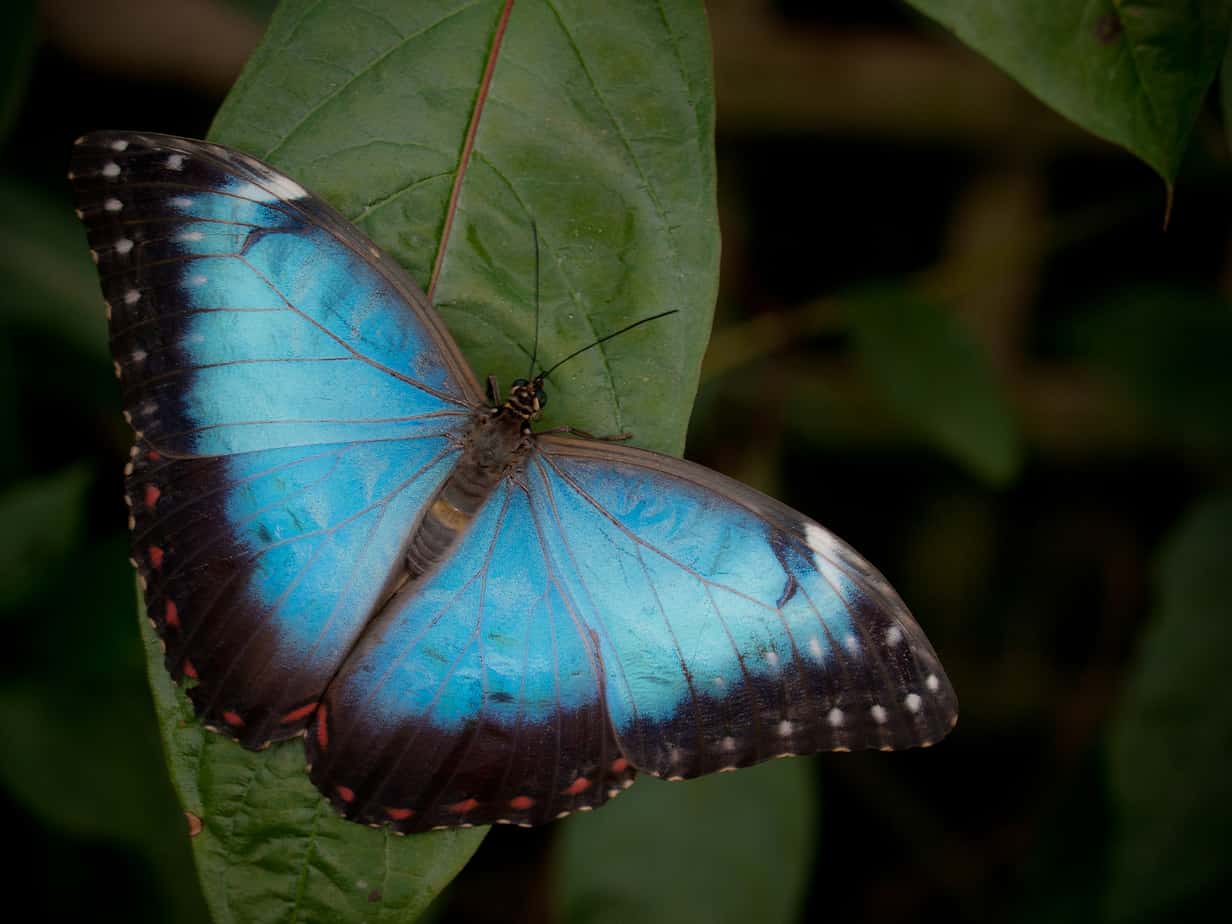
There’s little as beautiful as the delicate yet brilliant blue iridescence of a Morpho butterfly. But what gives the Morpho butterflies such as the Morpho Amanthonte, Morpho Zephyritis and Morpho Didius this beautiful shimmer? In this article we will take a look at this and other fascinating facts about the beautiful Morpho butterfly.
The beautiful Morpho butterfly can be found mainly in the rainforests of Central America. Specifically, Morpho butterflies are found in parts of Mexico, Brazil, Costa Rica, Venezuela and Peru. According to entomologist Adrian Hoskins, there are 29 species within the genus Morpho. What makes this family of butterfly different are their brilliant iridescence wings and large wingspan, ranging from 7.5cm up to 20cm in size!

Left, an extreme close-up of a Morpho butterfly wing showing the chitin. Right, the detail on a butterfly wing as the human eye sees it.
While we might see the butterfly wings as an iridescent blue or green, in fact the upper side of the Morpho butterfly wing has no pigmentation. The colours we see are caused by light refraction between tiny scales on the surface of the wing known as chitin. Each chitin is made up of hairs known as setae.

Morpho butterflies have eye-spots on the underside of their wings. These eye spots are known as “ocelli” and are a way for each butterfly to identify each other, but may also serve as another camouflage technique.
Not all Morpho butterflies have a blue or green iridescence on the top of their wings, but look at the underside of their wings and you will find that all of them resemble the jungle foliage with dappled browns, greys, reds and blacks. This is a clever camouflage against predators in the wild.
Together these setae come together to make each chitin diamond-shaped or “tetrahedral”, which is otherwise known as a “photonic crystal”. The colour they refract is in fact an optical illusion! This also means that the colour varies in different lights and at different angles.
It’s the male Morpho butterfly that has the most vivid colouring. This is to attract females and out-do any rival males. In this way, the butterfly kingdom and the bird kingdom are similar.
Papillon Belle directly supports the conservation of Morpho butterflies by supporting butterfly farms in South America that aim to protect the biodiversity in rainforests while increasing the populations of these beautiful butterflies. To read more on this subject please visit our page on Butterfly Farming.


Written by Audrey Westcott